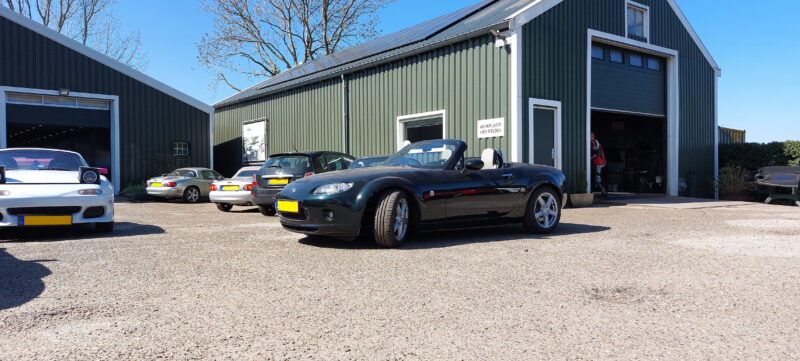
It’s finally happening: the Mazda MX-5 is officially sneaky.
When the car was first purchased, there was never any intention of changing much. That mindset has completely shifted since then.
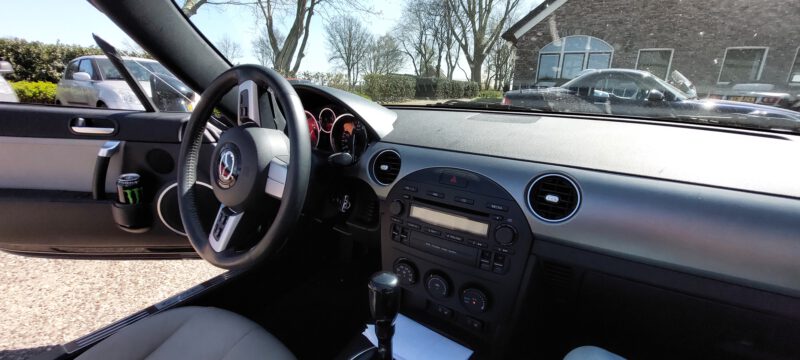
It was a shame the car didn’t come with cruise control, but given the overall condition, that felt like a small compromise. A small compromise—until it turned out that this generation was never offered with cruise control in Europe at all. After some research and asking around, a modified ECU with a custom wiring loom was installed. Combined with original steering wheel controls from the later facelift, everything now looks completely factory-original.
As fantastic as the car is to drive—especially with the roof down—the engine sound is quite muted. That led to a modification that’s slightly less OEM in appearance, though fortunately it’s only visible under the hood.
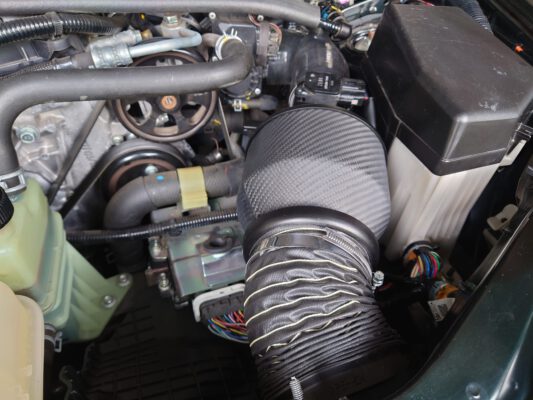
A Pipercross induction kit was fitted to give the car a more noticeable induction sound, without making it excessively loud or intrusive.
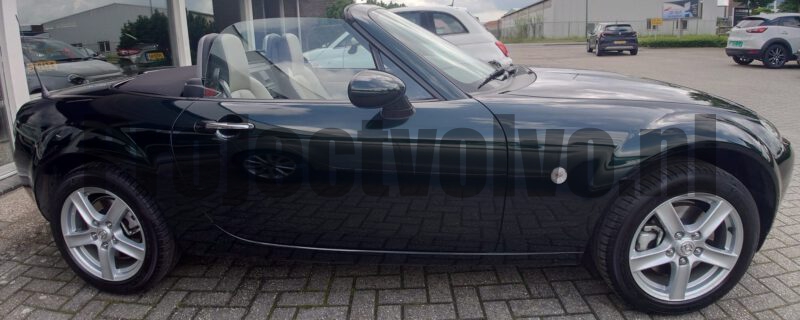
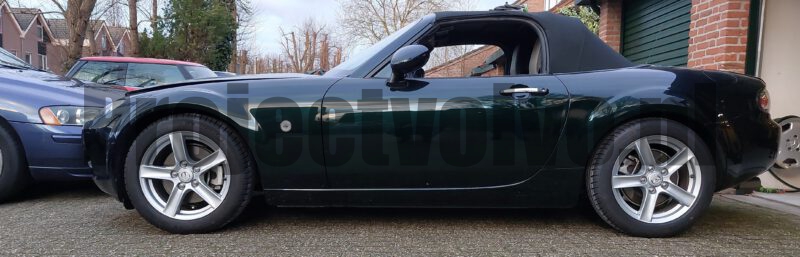
Then there’s the noticeably high ride height. Early NC-generation (NC1) MX-5s are well known for their surprisingly tall, almost SUV-like stance. Mazda already addressed this somewhat with the first facelift (NC2), lowering the ride height slightly from the factory.
Reason enough to install lowering springs, finally putting an end to the MX-5 SUV look.
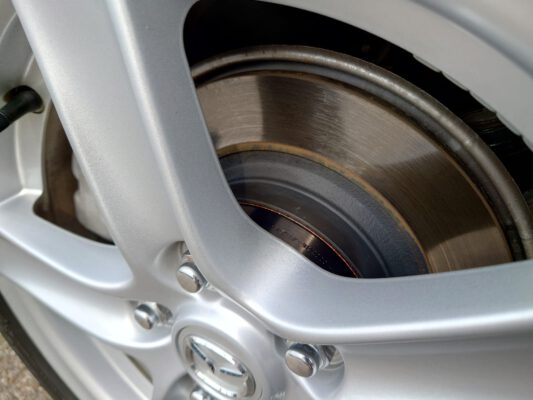
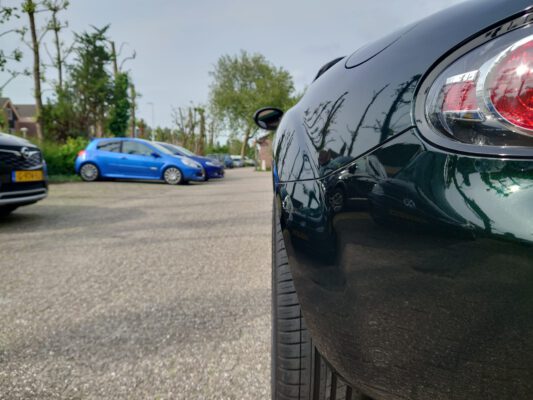
Combined with a set of wheel spacers, the overall stance now fills the wheel arches much more nicely.
Like any normal day, casually scrolling through social media, I suddenly came across an interesting piece of hardware: a G Racing short shifter for the 5-speed gearbox. Curiosity instantly kicked in. The asking price seemed very reasonable, so I sent a message—mostly out of interest.
The seller turned out to be friendly and helpful, and even offered it for an even better price. At that point, refusing simply wasn’t an option.
Installing the shifter itself was easy. Removing the interior trim, however, was far more frustrating. The MX-5 is already known as one of the best cars to shift gears in, but with this short shifter, it becomes a completely different experience.
Everything feels tighter and more direct. There’s no rubber isolation to dampen vibrations. Is it comfortable? Not necessarily. But the mechanical, click-clack sensation of shifting gears like this is incredibly satisfying.
Back to the ride height. The SUV look is gone—but it could still be tougher. The lowering springs actually made the car look the way it probably should have from the factory. Still, for a more aggressive, sporty appearance, another centimeter or two lower would be perfect.
After a lot of reading and research, the choice eventually fell on a set of TEIN Street Advance Z coilovers. Fully adjustable in both height and damping, they make it easy to tailor the setup for different types of drives.
Then comes the biggest consideration. The car was knowingly purchased with the 1.8 engine, the less popular sibling of the 2.0. There’s nothing wrong with the character of the 1.8—it offers plenty of power for enjoyable driving. Still, during the search for an MX-5, the 2.0 was always the preferred option.
The reason this 1.8 was chosen anyway is simple: it was in exceptionally good condition and exactly to our taste.
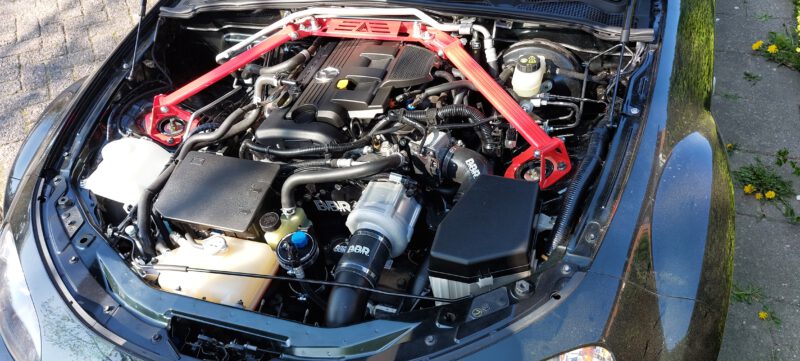
Finding aftermarket parts for an MX-5 is never difficult, and it didn’t take long before discovering BBR. They offer a package including camshafts and a new exhaust manifold, making the 1.8 more powerful than a standard 2.0. That sounded perfect—essentially turning our near-perfect 1.8 into a 2.0-like experience.
But then… there was more. Much more.
BBR also offers remaps, exhaust manifolds, camshafts—and even supercharger and turbo kits. That deserved a closer look. Their bolt-on kits are so well engineered that they look like factory equipment.
This is the route we’re taking.
The final choice was a supercharger kit: a centrifugal Rotrex supercharger combined with supporting hardware from BBR. Why not a turbo? While tempting at first, turbo conversions introduce more heat, rely on engine oil for lubrication, and can generate high boost at low RPM—adding significant stress to a stock engine.
Unlike a turbo, a supercharger is belt-driven. It’s mechanically simpler and delivers boost in a linear way, increasing with engine speed. That makes it much more forgiving at low RPM and far friendlier to a stock engine. The Rotrex unit also has its own independent oil system, complete with reservoir and oil cooler.
An intercooler is included as well, mounted alongside the oil cooler in front of the radiator.
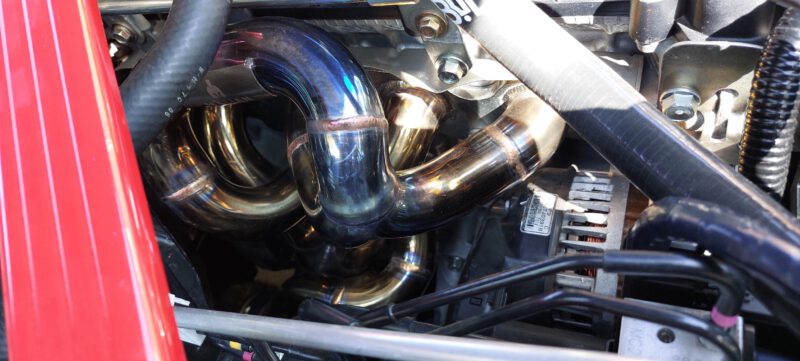
One more requirement for this kit is replacing the highly restrictive factory exhaust manifold. There are countless options available: equal length, unequal length, with or without catalytic converter. While an equal-length manifold without a catalyst offers the most power, the decision here was made to go for an unequal-length manifold.
Two cylinders follow a longer path, two a shorter one. The flow isn’t optimal, but the uneven exhaust pulses create a very distinctive sound, often associated with a Subaru Impreza.
Another advantage over a turbo setup: turbos tend to mute engine sound. With this setup, the character and noise remain very much alive.
The Dutch supplier of the BBR kit appears to be the only one locally with real hands-on experience. After getting in touch and receiving helpful advice, they offered a very attractive installation deal—too good to pass up.
The result? Completely stock on the outside—but the moment the engine starts, it turns into an absolute beast.
The engine fires up, the supercharger immediately makes itself heard, and the exhaust note has changed. The car wants to be driven. The first meters feel familiar, though the sound is clearly different. Apply throttle, and the supercharger gently begins to sing.
As revs climb, the supercharger screams louder and boost builds. At 3,000 RPM it already pulls harder than stock. At 4,000 RPM it feels eager. At 5,000 RPM the difference is overwhelming. Even near 6,000 RPM, where peak power is almost reached, the party doesn’t stop—don’t forget to shift, or you’ll hit the limiter before you know it.
It’s incredible how much the car has changed in just one year. A year ago, this would have seemed impossible—let alone reality.
The car is now officially a Sneaky Miata.